Unit 2.7 Study metadata
Overview
Unit study time
- 10 minutes
Intended Learning Outcome
By the end of the unit, you will be able to ...
- List core study‑level metadata elements
- Describe how study metadata supports discovery in repositories/catalogues
What is study metadata?
As we covered in the Introduction to Metadata course, study metadata captures information about the whole research effort. This metadata provides context on the who, what, when, why, where, and how of the overall research study. It also describes where the study's datasets are located and how they can be accessed.
Study metadata is sometimes referred to as catalogue metadata because it is often used by repositories, catalogues, and discovery systems to describe research studies and datasets. This metadata helps users of these sites to understand and discover different research studies.
Study metadata is also important for your personal records, even if you're not planning to deposit your data in a data repository or catalogue. Study metadata allows you to organise your research effectively, as well as preserve it for future use so you can come back to it at a later date and have all the necessary information to hand.
Many study-level metadata elements are based on the Dublin Core Metadata Element Set. More specialised standards, such as DCAT, extend these elements to support data catalogues and repositories
Study metadata elements
Core study metadata elements
Title The title of the research study
Creator The creator of the data, this could be the principal investigator (PI) of the study
Subject e.g. keywords or topics
Description e.g. an abstract or table of contents
Contributor e.g. people or organisations who contributed to the research process
Date e.g. the date range the research was conducted, the end date of the research etc.
Type The nature of the resource (e.g. study, dataset, software, documentation).
Format The format that the data is stored in
Language The language the data is stored in
Relation Any other publications or resources that are related to the study
Coverage The geographical coverage of the research study as a whole
If you're working on a larger research study and you're planning to share your data, you may want to include more metadata elements, such as...
Funder If the research study is receiving funding, the name of the organisations providing funding
Publisher The organisation responsible for making the study metadata or datasets publicly available.
Access rights If the (meta)data for the research study is shared online, you need to state the access rights to the data
Identifier If information about the research study and/or its data is available online, you should provide a DOI or PID to the online location
If you are depositing your data in a repository or catalogue, it is important to check the metadata requirements of those sites to ensure you capture any further metadata elements.
Example: Study metadata in a data catalogue
The screenshot below shows a study record from the CESSDA Data Catalogue.[1] See CESSDA Data Catalogue for the full record.
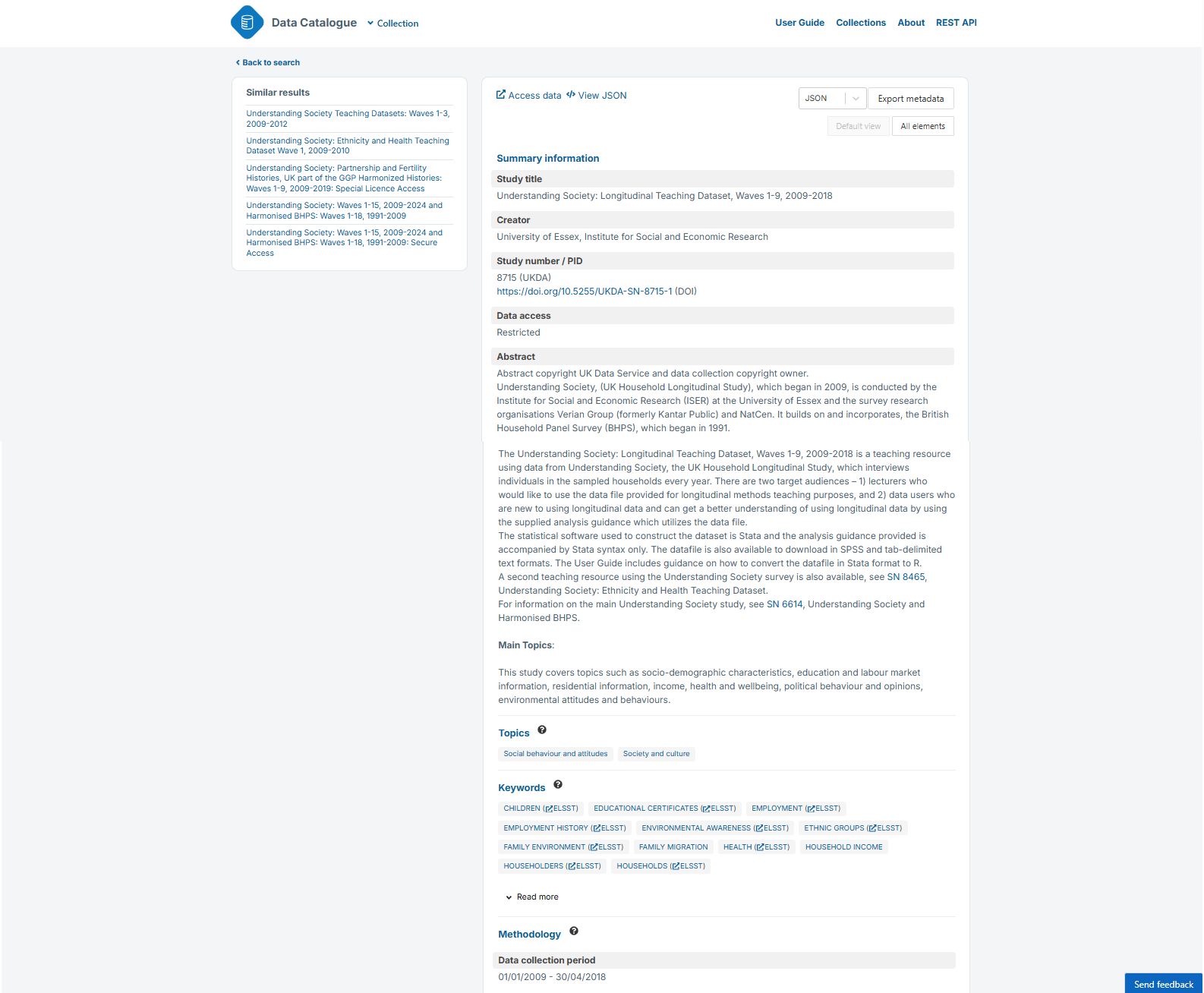
This record contains study-level metadata that helps users discover and evaluate a research study before accessing the data. Examples of metadata visible in the record include:
- Title
- Creator
- Description
- Subject
- Coverage
- Date
- Identifier
- Access information
By reviewing this metadata, a potential user can quickly determine whether the study is relevant to their research and how to obtain access to the data.
Study metadata provides an overview of a research project. To fully understand the data, study metadata should be linked to more detailed metadata about datasets, instruments, questions, measurements, variables, and codelists.
Test your knowledge
Which of the following is an example of study metadata?
- The categories for a variable
- The definition of a concept
- Aims or research objectives
- The code assigned to a response
Reveal answer
Aims or research objectives. Study aims and objectives are key elements of study metadata, providing context for why the data were collected.
How does study metadata relate to other types of metadata (e.g. variable, concept, measurement)?
- It provides the overall context within which other metadata can be understood
- It only applies to file formats
- It replaces them
- It is unrelated
Reveal answer
It provides the overall context within which other metadata can be understood. Study metadata provides the broader context, while other metadata types describe specific aspects of the data.
References
- [1] CESSDA Data Catalogue (2020). Understanding Society: Longitudinal Teaching Dataset, Waves 1–9, 2009–2018. Available at: https://datacatalogue.cessda.eu/detail/acd9f69153249516cf3760d8deda27feed4d6e2508cfebfd34a44eaf6fc8d056?lang=en (accessed 2026).